Here is a number that should make every pharmaceutical executive lose sleep: 90%.
That is how much blockbuster weight-loss drugs crashed in India in early 2026. Medications costing Rs 16,000/month dropped to Rs 5,000—with analysts predicting Rs 300-500 soon.
The drugs? Ozempic (semaglutide) by Novo Nordisk and Mounjaro (tirzepatide) by Eli Lilly—medications that turned their makers into half-trillion-dollar companies.
How did this happen? The answer is a masterclass in intellectual property strategy—how to build patent fortresses, and how they can be breached.
The Problem That Took 200 Years to Solve
- 4 million deaths annually from obesity-related diseases (WHO)
- 95% failure rate for traditional dieting
- $2.5 trillion global economic impact
We landed on the Moon and developed mRNA vaccines in months. Yet sustainable weight loss remained impossible—until GLP-1 receptor agonists arrived.
How These Drugs Work
Your gut produces GLP-1 after eating—it signals fullness and regulates blood sugar. Problem? Natural GLP-1 breaks down in minutes.
Semaglutide solved this by attaching a fatty acid chain, extending half-life to one week. Tirzepatide went further as a dual agonist, producing 22.5% average weight loss vs. 15% for semaglutide.
Results rivaling bariatric surgery—without the scalpel.
The Patent Fortress
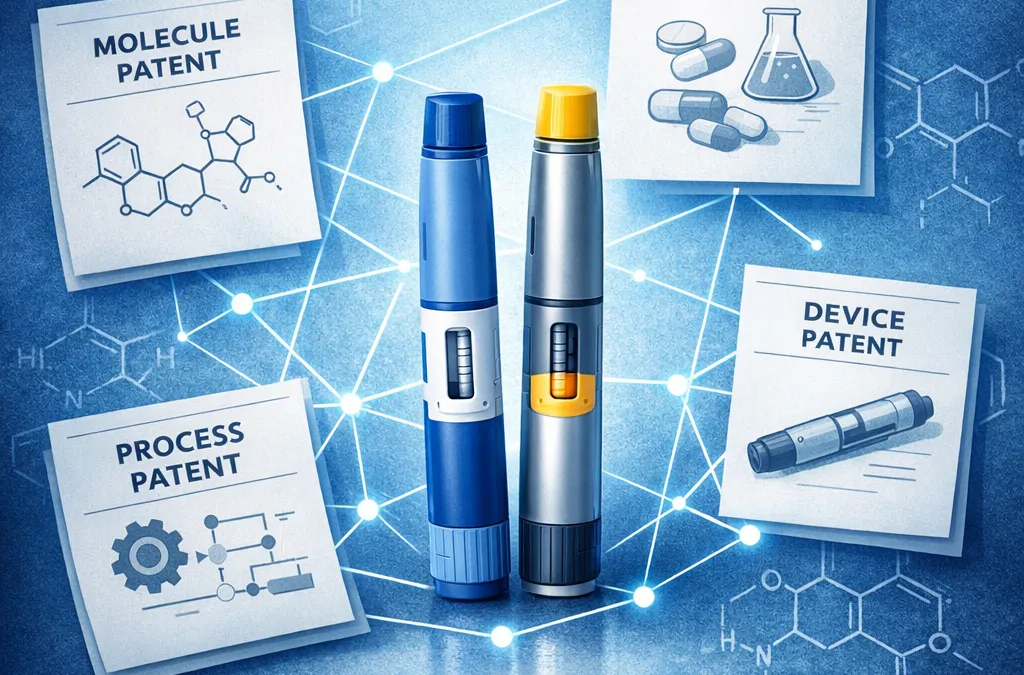
What Novo Nordisk and Eli Lilly built is not a single patent—it is a fortress with five layers:
1. Composition of Matter — The molecule itself. Broadest protection, earliest filing.
2. Formulation Patents — Specific doses, stability formulations. A 2015 filing extends protection to 2035.
3. Device Patents — The FlexTouch pen’s dose dial, injection depth, needle systems. Generics need expensive redesigns.
4. Method of Use Patents — How it’s used: treating obesity vs. diabetes, dosing regimens, titration schedules.
5. Manufacturing Process Patents — Recombinant production, purification protocols, quality assays.
Combined, these create a patent thicket: 100+ patents per drug, each requiring separate legal challenge at $5-10M per case.
India’s Section 3(d): The Fortress Breaker
Section 3(d) of the Indian Patents Act:
The mere discovery of a new form of a known substance which does not result in the enhancement of the known efficacy… is not patentable.
This invalidates most “evergreening” strategies:
| Strategy | US/EU | India |
|---|---|---|
| New salt form | Patentable | Not patentable |
| New polymorph | Patentable | Not patentable |
| New dosage form | Patentable | Not patentable |
| New use/indication | Patentable | Not patentable |
In 2013, India’s Supreme Court rejected Novartis’s Glivec patent under this provision—setting the precedent.
For GLP-1 drugs in India: core molecule patents may hold, but formulation and method patents likely won’t. Indian manufacturers can legally produce the active ingredient and develop their own formulations.
The Global IP Chessboard
Patent rights are territorial. A US patent provides zero protection in India.
| Factor | USA | EU | India | China |
|---|---|---|---|---|
| Patent term | 20 yrs | 20 yrs + 5yr SPC | 20 yrs | 20 yrs |
| Secondary patents | Accepted | Accepted | Limited | Increasingly accepted |
| Method of use | Patentable | Patentable | Not patentable | Patentable |
Five Lessons for Every Innovator
1. Think ecosystem, not invention. Don’t just patent your idea—control what surrounds it: variants, manufacturing, delivery, methods of use.
2. Time your filings strategically. Composition patents early. Formulation patents during development. Device patents at commercialization.
3. Plan global filing by market value. Tier 1 (file immediately): US, EU, Japan, China. Tier 2: Canada, Australia, South Korea. Tier 3: Case-by-case based on local patent law.
4. Build freedom-to-operate early. Patent landscape search, claim analysis, validity assessment, design-around mapping.
5. Monitor continuously. Track competitor applications, grants, litigation, and regulatory filings.
Why This Matters Now
- Novo Nordisk: $500B+ market cap—Europe’s most valuable company
- Eli Lilly: $700B+ market cap
- GLP-1 market: Projected $100B+ annually by 2030
These valuations rest on patent-protected revenue. When patents expire or are circumvented, value evaporates.
The Bottom Line
The GLP-1 saga teaches us that breakthrough innovation and strategic IP protection are inseparable.
Most people ask: “Is my idea patentable?”
The real question: “What all around this idea can I protect?”
Your IP strategy is not separate from your business strategy. It is your business strategy.
Ready to build your IP strategy?
Start Your Free Trial | Contact Us
References
- World Health Organization. Obesity and overweight. WHO Fact Sheet, 2024.
- Jastreboff, A.M., et al. (2022). Tirzepatide Once Weekly for Treatment of Obesity. NEJM, 387, 205-216.
- Wilding, J.P.H., et al. (2021). Once-Weekly Semaglutide in Adults with Overweight or Obesity. NEJM, 384, 989-1002.
- Supreme Court of India. Novartis AG v. Union of India (2013). Civil Appeal Nos. 2706-2716.
- FDA Prescribing Information: Ozempic (semaglutide).
Dharmik Patel is the Co-founder of PatentAssist.ai. He believes that understanding real-world IP strategies—from pharma giants to emerging startups—is essential for building defensible innovation.